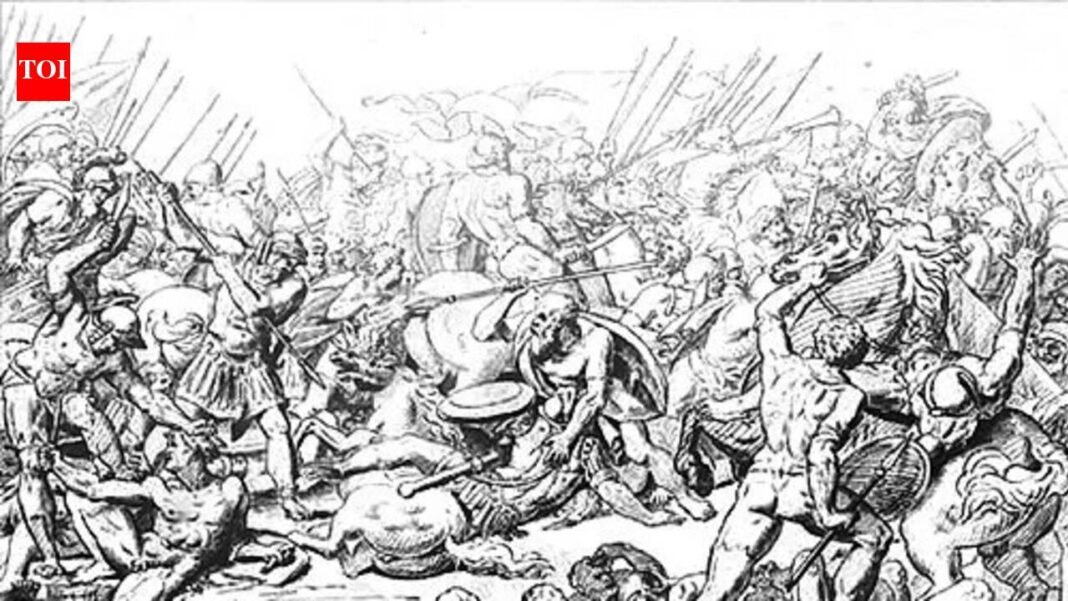
The Peloponnesian War lasted from 431 BC to 404 BC and was one of the most decisive conflicts in ancient Greek history. The war saw Athens and Sparta and their respective allies engage in a protracted war that not only redefined the Greek world, but in ways that went far beyond the scope of actual warfare. Although the war began as a power struggle, it quickly turned into a destructive conflict that destabilized society, drained the Greek world of power, and led to the weakening of the Greek world as a unified force. After the war, Greece was no longer the strong power it once was, but a Greece that was fragmented, fragile, and vulnerable to invasion from the outside world.
Peloponnesian War: The Clash of Power and Pride
according to The political economy of the original “Thucydides Trap” At its heart, the Peloponnesian War was a struggle between two distinct forms of government, Athens, a maritime democracy, and Sparta, an oligarchy with a land-based army. Thucydides, the ancient historian and participant in the war, noted that “it was the rise of Athens and the resulting fear in Sparta that made the war inevitable.”This quote reveals how fear, desire for power, and competition are part of this war. This war lasted for nearly thirty years. Athens used a powerful navy and Sparta used a powerful army. However, neither side was able to win the war quickly, leaving Greece suffering.
Economic Destruction and Social Collapse in Ancient Greece
this Cambridge University Press Point out that one of the main ways the Peloponnesian War affected ancient Greece was through economic devastation. The war caused significant damage to the economy and daily life. Farmland was destroyed, especially in Attica, where the Spartans invaded, forcing people to move into the overcrowded city of Athens.The plague Thucydides describes caused significant disruption to the economy and daily life. It creates “lawlessness” and destroys the fabric of society. It killed thousands of people, including the powerful leader Pericles, and destroyed the economic and social fabric.The city-states of ancient Greece suffered from a lack of resources and population. The economy is unstable and in chaos.
Political instability and loss of Greek unity
The war also brought political instability. Conflicts between democracies and oligarchies led to coups and political instability in various city-states. Thucydides noted that during this war “words must change their ordinary meanings,” alluding to the political instability of the time.The Greek city-states failed to cooperate and unite against foreign enemies. Instead, they fight each other. There are a series of alliances and trust between them is low. Even with Sparta’s victory in 404 BC, peace was not achieved. Sparta had problems keeping the peace, leading to further conflicts such as the Corinthian War.This was the end of Greece’s “golden age.”
Long-term consequences: Opening the door to Macedonian domination
However, perhaps the most lasting impact peloponnesian war It was the way it laid the groundwork for conquest by outside powers. The divided Greek city-states were unable to compete with the rising power of Macedonia.In the mid-4th century BC, King Philip II of Macedonia took advantage of the divisions in the Greek world to gain control of Greece, marking the end of the independence of the classical Greek city-states.The historian Xenophon, continuing Thucydides’ work, describes the aftermath of the war, emphasizing the instability caused by the conflict that lasted for decades.
A war that changed the course of Greek history
While the Peloponnesian War determined the outcome of Athens and Sparta, it also caused a complete disaster to ancient Greece. Economic, social, and political conditions have created a state of instability in which once-thriving civilizations are now weakened and disorganized.From the narratives of historians Thucydides and Xenophon, we can clearly understand the devastating effects that war can have on even the most powerful nations. This war proved conclusively that divisions between civilizations can ultimately destroy a civilization far more destructively than the opposing forces.