

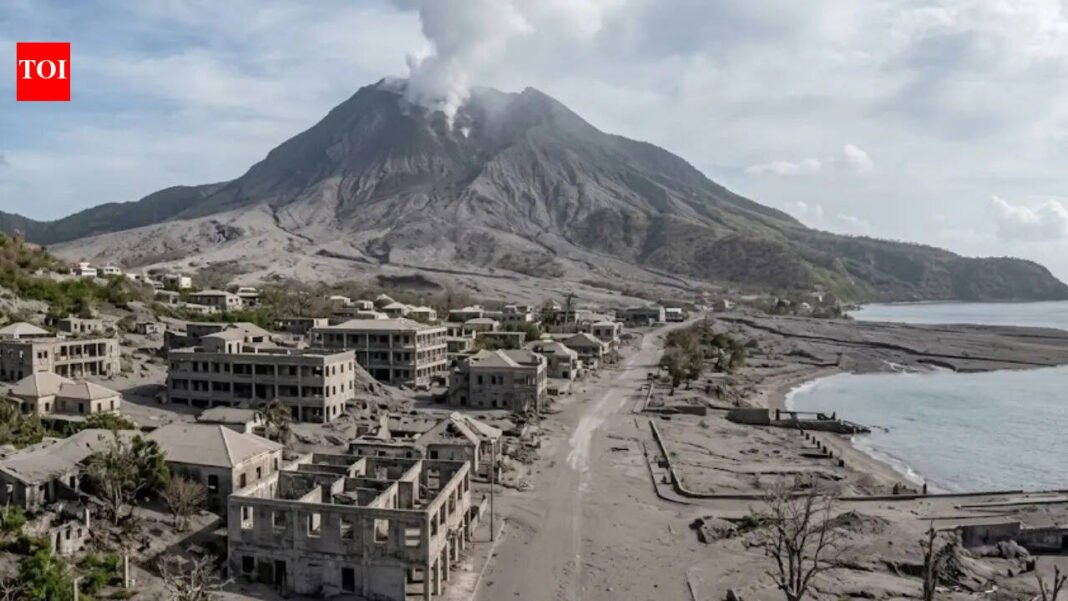
In 1997, Mount Soufriere erupted and buried the city of Plymouth on the island of Montserrat. The capital, once a bustling commercial center, was covered in a thick layer of ash and rubble within hours, leading to permanent evacuations. The Montserrat Volcano Observatory said more than 80% of Plymouth’s infrastructure was destroyed by the eruption. Although Plymouth is now an uninhabitable exclusion zone, today it remains the de jure capital of the island. The city has been likened to “modern Pompeii,” a reminder of the devastating impact of geology. It also provides scientists with valuable information about how volcanoes have impacted and replaced modern civilization over time.
how soufriere volcano wipe Plymouth off the map
Plymouth’s destruction was caused primarily by pyroclastic density currents (PDCs) – gravity-driven clouds of hot gas and rock. Research published by the United States Geological Survey (USGS) and the Montserrat Volcano Observatory (MVO) shows that these airflows have temperatures in excess of 400 degrees Celsius (752 degrees Fahrenheit) and travel at speeds in excess of 100 miles per hour. PDC flows behave like fast-moving liquids, and due to the fluidized nature of these high-velocity flows, they are able to completely cover a building from the base to the second floor with a dense matrix of fine ash and pozzolana. Through this rapid burial, Plymouth remained frozen, providing archaeologists with the opportunity to study volcanic ash and volcanic mud found in everyday objects of the 20th century. These artifacts represent a unique but fragile way in which archaeologists can understand life in the 20th-century Caribbean.
How MVO monitors structural decay in restricted areas
Montserrat’s de jure capital, Plymouth, had been destroyed, including all of the city’s infrastructure. However, the Montserrat government noted that while the government has moved its administrative functions to Brades in the north of the island, Plymouth’s legal status as the official seat of government remains in the constitution and other records. The southern half of Montserrat is designated Zone V Restricted Area and is inaccessible without a police escort due to the ongoing threat from the volcano. This ongoing and complete legal and physical isolation of the city allows the Montserrat Volcano Observatory (MVO) to use GPS and seismic sensors to study accelerated structural damage and corrosion loads caused by the weight and chemical acidity of volcanic ash.
How volcanic ash reshaped Montserrat’s landscape
According to research in the Journal of the Geological Society, the massive amounts of volcanic material deposited in Plymouth permanently reconfigured the island’s topography and expanded its coastline. The ash layer was more than 12 meters (39 feet) thick in some areas, altering the island’s drainage basins and coastline. In addition, the high porosity of volcanic ash can act as an insulator. So, combined with the lack of light, it created a slow rate of decay for all the organic materials and household artifacts that might be buried beneath it.According to data from NASA’s Earth Observatory, these environmental changes produced specialized pioneer plant species within the exclusion zone and provide a unique model of biological succession in post-eruptive tropical environments.