

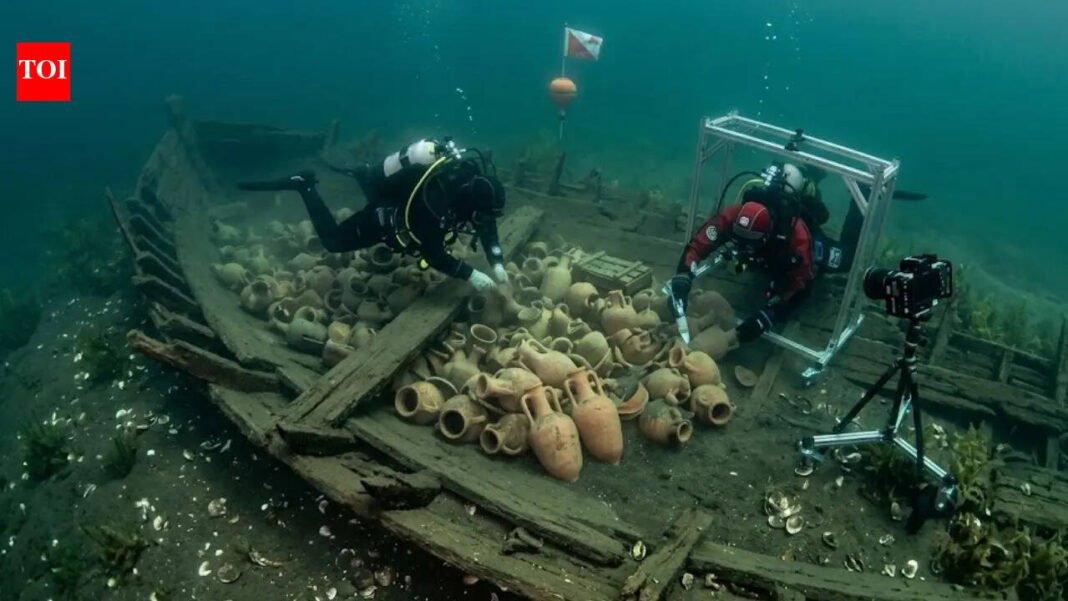
Swiss archaeologists have discovered a shocking Roman shipwreck in Lake Neuchâtel. The site is an unexpected treasure trove of first-century maritime trade. The site was revealed through drone photography in 2024 and excavated by the cantonal archaeological office (OARC) in March 2025, according to Swiss national media. More than 600 artifacts were unearthed at the site, the most notable of which are hundreds of complete ceramic vessels and amphorae used to transport Spanish olive oil. Another unique feature of this wreck site includes the presence of military equipment, such as two intact daggers, which indicate that it was a civilian merchant ship with a military escort provided by an army corps. This wreck site therefore helps fill in the gaps in the knowledge of the combined land and sea routes that connected the Mediterranean to the Roman frontier north of the Alps.
2,000-year-old Roman shipwreck discovered and excavated in Lake Neuchâtel, Switzerland
The identification of Roman shipwrecks began in 2024, using high-definition drone photos to identify the outlines of ships beneath lake sediments. Following the aerial discovery, the state Office of Archeology (OARC) conducted a formal underwater excavation of the site in March 2025. The mission was carried out by a collaborative team of professional divers and marine archaeologists who completed 3D photogrammetric mapping of the site and collected fragile archaeological material. This “time capsule” remains intact due to its 2,000-year preservation in specific lake sediments, preventing the organic and metallic structures from being exposed to oxygen and deteriorating.
Cargo and logistics found in 2,000-year-old Roman shipwreck
The archaeological site yielded an unprecedented number of artifacts (over 600 items), the most important of which are hundreds of complete ceramics and amphorae. As Swiss national media writes, scientific analysis of the clay and residue in these ceramic vessels confirmed that they were used to transport olive oil from Betika, present-day Spain. The presence of these ceramics in Swiss lakes highlights the extensive geographical reach of the Roman logistics system, suggesting that “liquid gold” from the Mediterranean could be widely available to the inhabitants and soldiers occupying areas as far north as the Alps. The large number of ceramics and the diversity of their forms suggest the existence of a highly organized supply chain that catered to the tastes of the Roman settlers and the armies stationed in the area.
Military evidence from 2,000-year-old Roman shipwreck
A very important find in the wreck site was military equipment, specifically two complete Roman short swords. According to the Octopus Foundation, the swords are believed to indicate a merchant ship with no military purpose being escorted by the Legion. In the first century AD, the transportation of valuable commodities such as olive oil across large tracts of land could be disrupted by civil unrest and piracy. This discovery established the physical presence of the Roman government as part of the security apparatus, providing military protection for the commercial interests of the Roman Empire and its means of transporting the goods needed for the economy.
Roman shipwreck as hub multimodal transport trade
The wreck is one of many links in the study of the Roman Empire’s “intermodal” transport system, in which goods were moved by sea, river and land. According to research published in ResearchGate, Lake Neuchâtel plays an important role as an inland distribution point connecting the Rhone and Rhine rivers. Researchers examining the placement of goods at the site will ultimately provide a clearer understanding of the combined use of land and waterways to support the activities of the Roman Empire north of the Alps. The discovery also confirms that the Swiss plateau is not a remote outpost, but a busy corridor of international commercial activity and integrated into the wider Mediterranean economy.