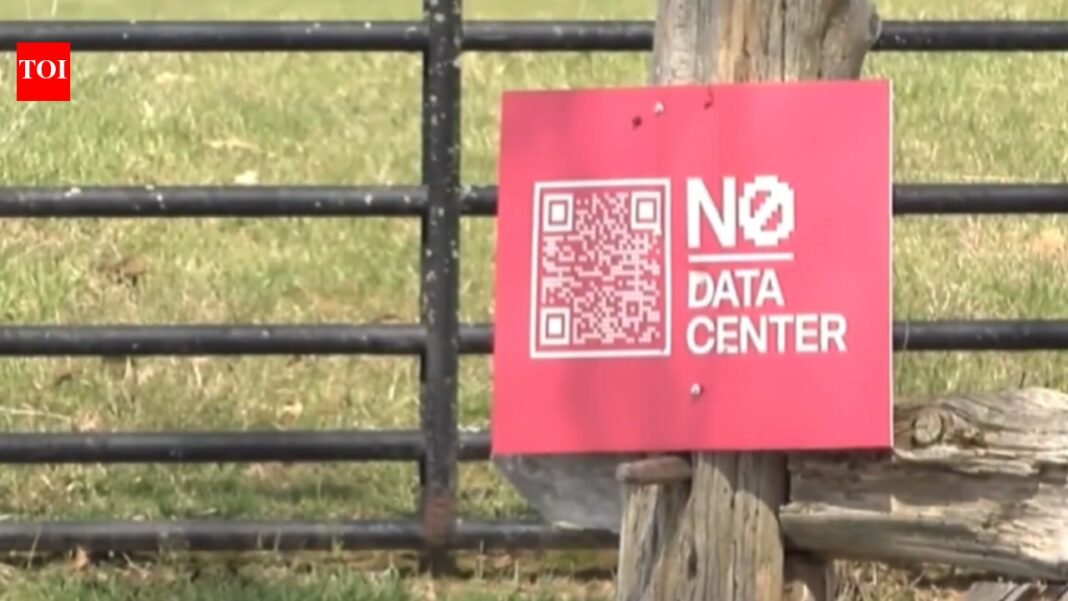
A northern Kentucky farming family turned down a $26 million offer from a Fortune 100 company seeking to build a massive artificial intelligence data center, choosing instead to keep the land they believe is worth more than the money.The Huddlestons’ decision raises eyebrows as tensions play out in parts of the country between expanding digital infrastructure and long-held agricultural land.
Generational farm at center of growing dispute
The Huddleston family has worked for generations on their 1,200-acre farm in Mason County, Kentucky, producing cattle for the wider region. The land has experienced significant historical periods, including the Great Depression, when the family helped feed the local community. That continuity is now under pressure. According to Delsia Bare, a member of the family, they were approached by an undisclosed company last April with an offer of $26 million for the roughly 900-acre property outside the city limits of Maysville. There are plans to build a large data center campus. “It’s heartbreaking [the land] My first feeling was that it might disappear. Literally, pain in the chest where the heart is,” Bell told us Live 5 WCSC.

Delsia Bare and her mother Ida Huddleston turned down a $26 million offer, saying generations of Kentucky farmland was priceless/Photo: Fox 19
Her mother, Ada Huddleston, flatly rejected the offer. “I said, ‘No, my stuff is priceless.’ What I have here, I want to pass it on. What God told me to do is keep it until I’m done with it and then pass it on to the next generation,” she said.
Projects with economic weight
The proposed development would extend beyond the Huddleston area. Plans show 28 properties totaling more than 2,000 acres will be rezoned.Maysville City Manager Matt Wallingford told the outlet the scope of the potential project is significant, calling it “significant to us.” Wallingford said the data center could create more than 1,000 construction jobs and more than 100 permanent positions averaging $100,000 a year within eight to 10 years. He also noted that national tariffs would require the company to fund additional infrastructure. “I know it’s a lot, but I know Kentucky has passed a tariff that requires the project to pay for all the electricity, which means building a second power plant that’s comparable to what we have now at no cost to ratepayers. There will be no increase in electricity prices for those who get power from RECC,” he said. The facility will use a closed-loop water system to reduce the risk of contamination, and its waste output will be comparable to existing large retailers or factories, he added.
Concerns about land, water and long-term impacts
For the Huddleston family, the issue is more than just a sale. They expressed concern about the strain on water systems, strain on the electric grid and the permanent loss of fertile farmland. “You know, they call us all stupid farmers, but we’re not. We know that when our food disappears, our land disappears,” the family said. Wallingford acknowledged the concerns but said the land could retain value even if its use changes. “I agree with that,” he said. “But that doesn’t mean the buildings can’t be repurposed along with the infrastructure there. Our industrial authorities will be recruiting new businesses to come in, so I think the land will be valuable wherever the data centers are.”
“My things are priceless”
For Ada Huddleston, the decision was also personal. Her home on the land was built by her late husband, and she said she plans to stay there. “He was always there for me, telling me what I was going to do with the farm the next day and the day after, just like he wanted it to be. He was a different person,” she said. Both she and Bell made it clear that any financial offer would not change their stance. The family said they will continue to resist the proposed development despite mounting pressure from local officials who say the project could reshape the region’s economy.