

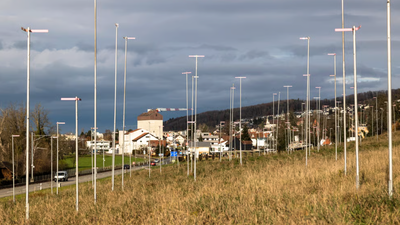
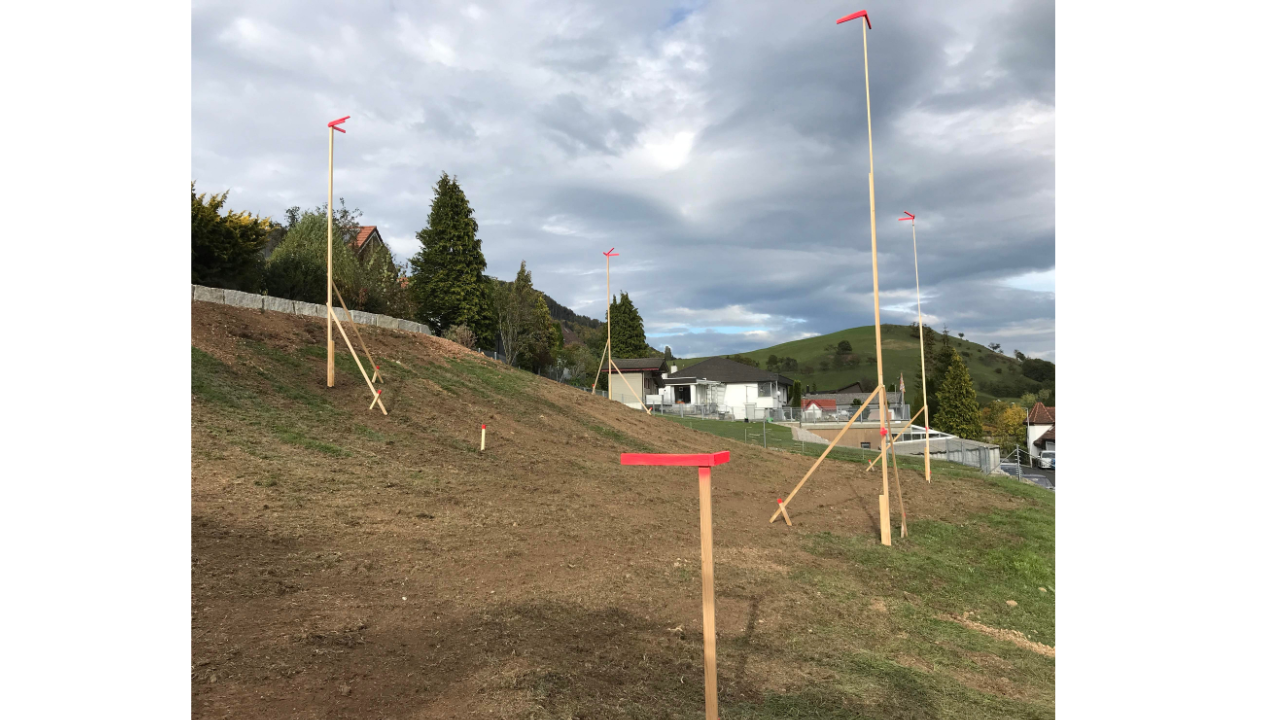
In Switzerland, construction work doesn’t start with concrete or a crane, but with something more unusual. Empty frames depict the future. Weeks before construction is approved, tall columns rise from the ground and are connected by thin lines, drawing walls, roofs and balconies in mid-air. Known as Bauprofiles, these full-scale profiles transform architectural drawings into physical reality. They allow anyone who walks by to observe, judge and even challenge buildings before they are built, turning urban planning into a visible, participatory process rather than a purely bureaucratic one.
How high to draw telegraph poles before house construction in Switzerland
Bauprofile creation is simple and precise. Surveyors first convert building plans into precise ground coordinates, marking the structure’s footprint. From there, tall poles, often several meters high, are installed at strategic points such as corners, roof ridges and facade edges.These poles are then connected using rope, wire, or wooden slats to define the building’s exterior geometry. In some cases, additional markings indicate balconies, terraces or pitched roofs, giving a surprisingly accurate sense of volume. Although the structure lacks mass, it conveys proportions with stunning clarity. Standing next to it, one can gauge not only the dimensions but also the presence of the building and how it feels within the space it occupies.Bauprofile is not an aesthetic choice. They are integrated into Switzerland’s planning framework. After a construction proposal is submitted, authorities require its actual outline to be shown during a formal notification period, which usually lasts two to three weeks, depending on the state.This period is very critical. Neighbors and local stakeholders can review the proposal under real-world conditions and raise objections if necessary. Concerns may range from sun shading and altered views to broader community character issues. By making proposals fully visible, the system ensures that objections are based on lived experience rather than abstract interpretations.
Why drawings and renderings are not enough
Architectural planning, no matter how detailed, requires a level of spatial imagination that most people do not possess. Even advanced 3D renderings can be misleading, often presenting an idealized perspective that fails to capture real-world impacts.Bauprofile addresses this gap by placing the building directly into its environment, albeit as a skeletal form. Observe shadows, test sight, and understand proportions instantly. What seems acceptable on paper may feel overwhelming when actually outlined, and vice versa. This immediacy reduces misunderstandings and prevents disputes from escalating after construction begins.
A system that redistributes power
One of the most important aspects of Bauprofile is how they transfer influence during the planning process. Decision-making is no longer limited to architects, developers and regulators, but provides a tangible basis for participation by ordinary residents.That doesn’t mean every objection will stop a project, but it does ensure it’s harder to ignore the concerns. Developers, aware that their plans will be subject to public scrutiny in physical form, often adopt more responsive designs from the start. In this way, Bauprofile serves as both a preview and a form of accountability.
Can invisible building Working outside Switzerland?
The ideas behind Bauprofile are universal, making future developments easy to understand before they are even built. Such systems could enhance transparency and trust in cities that are grappling with disputes over space, skylines and environmental impacts.However, its success depends on more than just implementation. It requires a legal framework that allows the public to make meaningful objections, and a willingness on the part of developers and authorities to adapt to the process. Without these conditions, the poles become symbolic rather than functional.
See the future before it comes
Switzerland’s “invisible architecture” demonstrates a simple but powerful principle. People make better decisions when they can clearly see the consequences. By converting plans into physical outlines, Bauprofile bridges the gap between imagination and reality.In an age dominated by digital visualization, this analog approach feels almost counterintuitive. Yet its effectiveness lies precisely in its simplicity. Before anything is built, the future manifests itself briefly, giving communities a rare opportunity to engage with what is to come rather than react to what has already been done.