

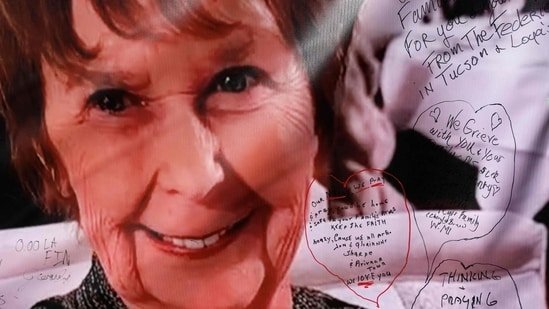
“Today” host Savannah Guthrie and her family issued a new statement in an urgent plea to the Tucson community and Pima County officials for new information in the disappearance of her mother, Nancy. Meanwhile, the search for the 84-year-old has entered its seventh week. Although authorities released surveillance video of the suspects, no one has been identified.

Savannah Guthrie’s new statement
“We are deeply grateful for the outpouring of love from our neighbors, friends and the people of Tucson. We are all a family now,” the broadcaster said.
Read more: Nancy Guthrie investigation: Pima County Sheriff sends urgent message to kidnapper; ‘Take her to…’
The statement further reads: “We continue to believe that Tusonan and the greater southern Arizona community hold the key to solving this case. Someone knows something. Members of this community may have important information that they are not even aware of. We want people to search their memories, especially the critical timeline of January 31st, the early morning hours of February 1st, and the late night of January 11th.”
“We urgently ask this community to return attention to our mother’s case – please review camera footage, diary notes, text messages, observations or conversations that may be significant in retrospect. No detail is too small. That may be the key.”
Read more: Nancy Guthrie’s kidnapper was ‘someone close’; bombshell revelations as new revenge theory emerges
“Nancy Guthrie may be dead”
However, one expert says he believes the Nancy Guthrie case is no longer a “missing person case.” Former law enforcement official and CEO of the National Cold Case Center Morgan Wright, interviewed by Brian Entin, points to key evidence that points to something far more serious.
“At a certain point, you have to realize this is no longer a missing person. We have to realize Nancy is an 84-year-old man with heart disease,” he said. “At 2 o’clock in the morning you were subjected to violence in your own home. We knew it was violence because there was blood.”
“No one kills”
Wright added that blood at the scene and signs that she had been forcibly removed from the home indicated a violent confrontation.
“You still have blood. You still get kicked out of your house. It was a violent confrontation. So my question is, ‘I realize everybody said, well, we want, you know, we want her back,'” he said.
“I’m more of a pragmatist. It’s like when you investigate things you have to use both your left brain and your right brain. You have to compartmentalize,” Wright added. “I say you need to treat this as a homicide by no one because it tells the public what you’re looking at and where you’re looking for something.”
Wright said continuing to treat the case as a missing persons situation could limit the scope of the search.
He explained that in areas like the Catalina Foothills or the Sonoran Desert, if investigators don’t actively look for signs of hidden burials, they may overlook key clues.
“When we have unoccupied homicides, we look for clandestine cemeteries, open cemeteries, hidden cemeteries — those are the things you look for when you’re walking in the foothills.”
Family and authorities have not confirmed Nancy’s death.
Who is Morgan Wright?
Wright previously served for 18 years as a trooper and detective in state and local law enforcement and is now an internationally recognized expert in cybersecurity, intelligence and national security.
His previous positions include senior advisor to the U.S. Department of State’s Counterterrorism Assistance Program, senior law enforcement advisor to the 2012 Republican National Convention, and teaching behavioral analysis at the National Security Agency.