
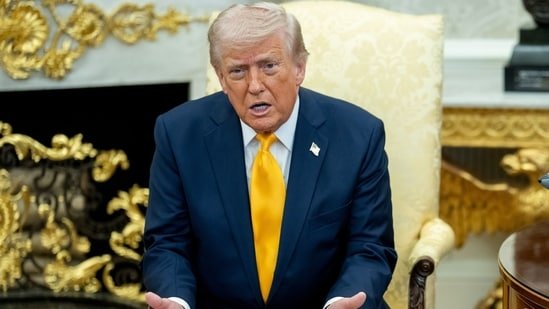
President of the United States Donald Trump Iran’s threats to escalate the war by attacking energy facilities in the Gulf could expand hostilities, deepening the regional crisis and heightening concerns in global markets.

Two attacks occurred overnight in the southern Israeli towns of Arad and Dimona, leaving dozens injured. Air raid sirens sounded across Israel in the early hours of Sunday morning, warning of missile attacks from Iran.
The Israeli military said on Sunday it was an attack Tehran It came just hours after Iran attacked southern Israel.
Trump threatened on Saturday that he would “destroy” Iran’s power plants if Tehran did not fully reopen the Strait of Hormuz within 48 hours. The major escalation comes just one day after he spoke of “ending” the war, now in its fourth week.
Iran warned on Sunday it would attack U.S. infrastructure, including energy facilities in the Gulf, if Trump follows through on his threats as U.S. Marines and heavy landing craft continue to travel to the region.
The war launched by the United States and Israel on February 28 has killed more than 2,000 people and roiled markets, soared fuel costs, heightened global inflation concerns and shaken the postwar Western alliance.
increased uncertainty
IG market analyst Tony Sycamore said: “President Trump’s threats have now planted a 48-hour time bomb in the market, exacerbating market uncertainty. If the ultimatum is not withdrawn, we may see global stock markets reopen on Black Monday, with stock markets plummeting and oil prices rising sharply.”
Sykamore said Tehran’s possible attacks on Gulf energy facilities in Saudi Arabia, the United Arab Emirates and Qatar “would deepen and prolong the pain of rising energy prices.”
Oil prices soared on Friday, hitting their highest level in nearly four years, after Iraq declared force majeure on all oil fields developed by foreign companies, Israel attacked a major Iranian gas field and Tehran responded with attacks on neighboring Saudi Arabia, Qatar and Kuwait.
Iran’s attack effectively blocked the Strait of Hormuz, a narrow chokepoint that carries about a fifth of the world’s oil and liquefied natural gas supplies, triggering the worst oil crisis since the 1970s. The plant’s closure caused European natural gas prices to surge 35% last week.
“If Iran cannot fully open the Strait of Hormuz without threat, within 48 hours from this time, the United States of America will strike and destroy each of their power plants, starting with the largest ones!” Trump posted on social media at around 7:45pm ET (2345 GMT) on Saturday.
Reports published in Iranian media on Sunday quoted Iran’s representative to the International Maritime Organization as saying that the Strait of Hormuz remained open to all shipping except vessels linked to “enemies of Iran.”
Ali Mousavi spoke to Chinese news agency Xinhua earlier this week after Trump threatened to attack Iranian power plants if the strait was not “fully open” within 48 hours. Mousavi said passage through the waterway was possible by coordinating security and safety arrangements with Tehran.
Ship tracking data shows that some vessels, such as an Indian-flagged vessel and a Pakistani oil tanker, have negotiated safe passage through the strait. Pakistan has good relations with Iran and maintains close ties with the United States and Saudi Arabia.
Iran’s Khatam al-Anbia military command headquarters said on Sunday that Iran would launch attacks on all U.S. energy, information technology and desalination infrastructure in the region if the United States attacks Iran’s fuel and energy infrastructure.
The Islamic Republic’s power grid is closely connected to its energy sector. Attacks on major plants could trigger blackouts that could paralyze everything from water pumps and refineries to export terminals and military command centers.