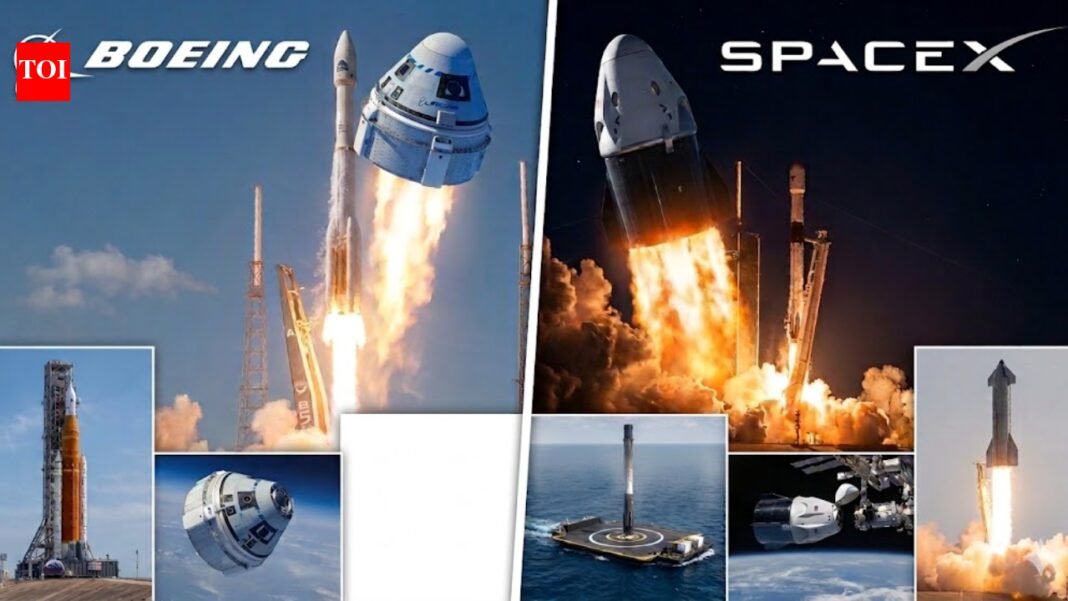
NASA’s goal of sending astronauts back to the moon is gathering pace, but there’s a change that’s affecting major players in the space industry. As of February 2026, the agency announced plans to expand the Artemis mission, adding an additional flight in 2027 and planning a lunar landing annually thereafter. SpaceX’s powerful Starship is taking on an important role as the Human Landing System (HLS), potentially leading lunar transportation and landings, while Boeing’s Space Launch System (SLS), once the primary vehicle for deep space missions, faces a bleak future, according to Bloomberg. The change allows Orion to remain relevant due to delays and cost concerns, but also reevaluates the heavy lifting. “NASA is committed to using the SLS architecture, at least through Artemis V, as necessary to support HLS providers and their associated accelerated plans to return U.S. astronauts to the Moon,” NASA Administrator Isaac Mann said in a statement provided by an agency spokesperson.
Starship first lands on the moon
Starship plays an important role in NASA’s moon landing program. It was originally the Human Landing System (HLS) used to transport astronauts from orbit to the surface. Now it is considering other missions, such as sending the Orion spacecraft to the moon, a role originally assigned to the SLS Block 1B upgrade. NASA announced on February 27 the establishment of standardized aircraft configurations to improve reliability. It also includes a low-Earth orbit (LEO) test rendezvous with a Starship or Blue Origin lander in 2027, ahead of Artemis IV’s planned landing in 2028. The adjustment speeds up progress in response to competition from China. Isaacman emphasized the need for speed, saying, “With credible competition, we need to go faster.” Deputy Administrator Amit Kshatriya emphasized the importance of the goal of executing landing missions in the same Earth-ascent configuration, prioritizing Block 1 configurations over riskier changes.
Boeing SLS Reduced participation
Boeing, the manufacturer of the SLS core stage at the Michoud Assembly Plant, now sees its SLS ambitions waning. SLS no longer sends the Orion spacecraft into lunar orbit and now only performs launches from Earth orbit. These changes reduce the upgrade and production ramp for future SLS Block upgrades. However, Boeing’s Steve Parker assured the public that “Boeing is a proud partner…our employees and supply chain are ready to meet growing production demands” and promoted the SLS as “the world’s most powerful rocket stage.”Orion may survive as a crewed return vehicle, but propulsion limitations underscore Starship’s reusability, and SLS costs up to $4 billion per mission.
The future of Artemis and SpaceX’s dominance
Artemis III transitions to LEO system checks such as docking, life support and xEVA suits to facilitate smoother lunar jumps. “Our team is ready for the challenge…of achieving a more frequent cadence,” lamented Lori Glaze. As April’s Artemis 2 launch approaches, this new era of starships will return to the moon faster after helium repairs, combining old technologies with innovative visions for lasting presence.