
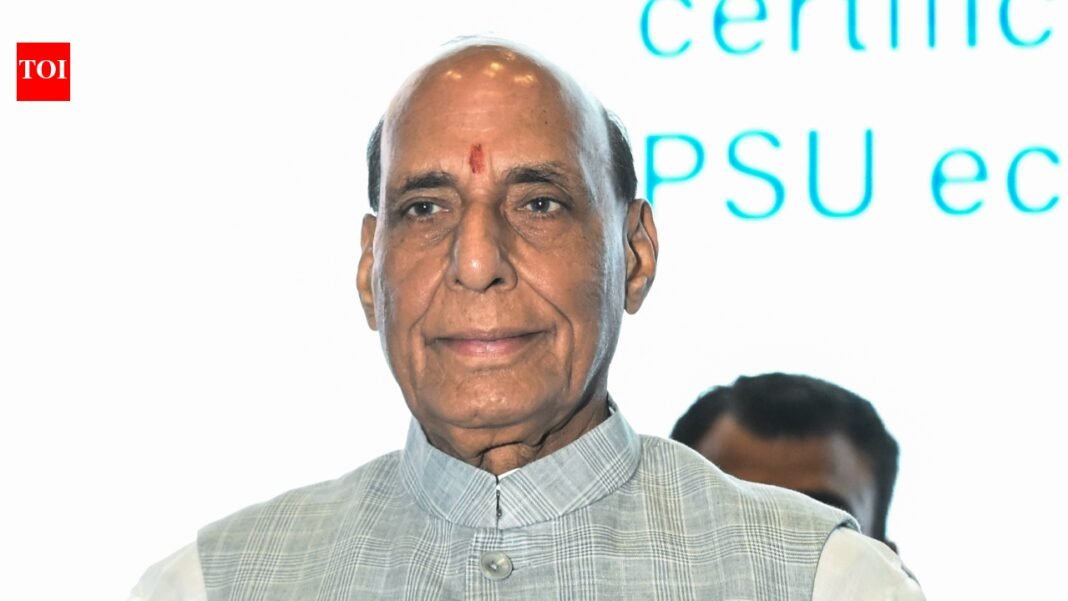

New Delhi: Defense Minister Rajnath Singh Emphasizing on Thursday that given the current geopolitical uncertainty, there is an urgent need to establish a drone production ecosystem in the country to ensure strategic autonomy, enhance defense preparedness and make the country self-reliant in the field.“India must work in mission mode to become a global hub for indigenous drone manufacturing in the next few years,” Rajnath said while inaugurating a defense industry conclave here.He said that ongoing conflicts, from the Russia-Ukraine conflict to tensions between Iran and Israel, prove that drones and counter-drone technology are destined to play a key role in future wars, and the “atmanirbharta” in drone manufacturing is not only crucial at the product level, but also at the component level.“From drone molds to software, engines and batteries, everything has to be made in India. This is not an easy task. In most countries that manufacture drones, a large number of key components are currently imported from China,” he said.Rajnath said that while the creation of a defense industrial ecosystem in any country relies on contributions from large industries, MSMEs, start-ups and innovators, it is equally driven by clear policy thrust by the government that is geared towards meeting the specific defense needs of the country. While he called on the private sector to actively contribute, he said the government would fully support transforming India into a global hub for indigenous drone manufacturing.The minister described iDEX (Defence Excellence in Innovation) and ADITI (Accelerating Innovative Technology Development through iDEX) as game-changing initiatives through which start-ups, innovators and MSMEs are given the opportunity to develop novel solutions to meet the specific requirements of the defense forces.He said, “Since the establishment of iDEX in 2018, as of February 2026, 676 startups, MSMEs and individual innovators have joined the defense innovation ecosystem. A total of 548 contracts have been signed; 566 challenges have been launched.” Of these, 58 prototypes have been approved for purchase, worth approximately Rs 3,853 crore, he said.“In addition, 45 procurement contracts worth nearly Rs 2,326 crore have been signed. These figures indicate that innovation is gradually being translated into tangible products and technologies, and the role of our start-ups and MSMEs in this transformation is steadily increasing,” Rajnath said.
Previous article

Next article