

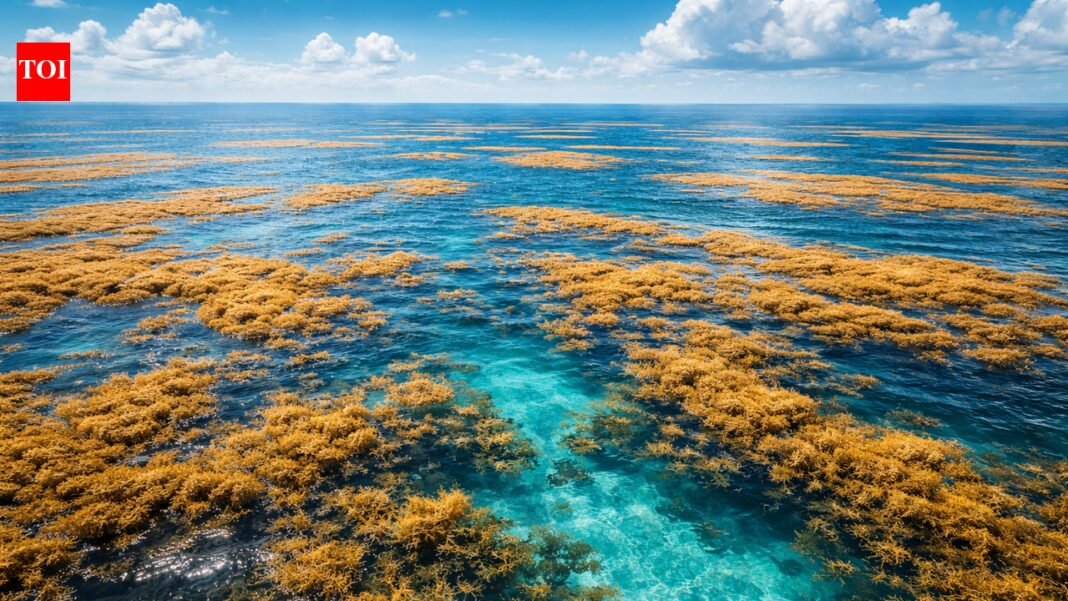
Ever imagined sailing endlessly across a seemingly infinite horizon of blue water with no sign of land in sight? There are no soft white sand beaches or rocky cliffs and headlands to mark the edge. This isn’t a sailor’s worst nightmare. This is the Sargasso Sea, the only ocean in the world that has no land borders because it has no coast. Located deep in the heart of the North Atlantic, this mysterious ocean fascinates scientists and the world with its unique features and its importance in the ocean’s life cycle. With its water so deep and so clear, and visibility often exceeding 50 to 60 meters, scientists have long been amazed by its unique features. For centuries, explorers have viewed the ocean as a haven for lost ships and sailors trapped in kelp-choked waters. Today, we know it is an important part of the world’s oceans. As climate change disrupts ocean waters, understanding the Sargasso Sea becomes increasingly urgent. So why is it the most mysterious ocean on Earth?
Sargasso Sea: the only sea without a coast
The Sargasso Sea is unique in that it is the only ocean in the world that has no borders with national territories. Unlike any other ocean in the world, it floats in the ocean and is surrounded by four powerful ocean currents.
- Bounded to the west by the strong Gulf Stream
- to the north, to the north
Atlantic current - In the east, near the Canary Current
- In the south, influenced by the North Atlantic equatorial current
These currents combine to form a giant clockwise circulation that keeps the water and everything in it in an ever-changing pattern some 2 to 5 million square kilometers wide.The boundaries constantly change with the seasons and weather, and depend on the Azores high pressure center. A scientific report published in 2011 defined its boundaries based on ocean currents, seaweed growth and ocean depth, locating it between 22° and 38° north latitude and 76° and 43° west longitude, with a total area of 4.16 million square kilometers. “While all other oceans in the world are at least partially defined by land boundaries, the Sargasso Sea is defined solely by ocean currents,” states NOAA, emphasizing its absolute uniqueness. The lack of shore creates a silence amidst the churning of the Atlantic Ocean, with visibility deep into the crystal-clear waters. No wonder early navigators such as Christopher Columbus feared it in 1492, mistaking its kelp mats for shoals that could destroy ships.
Why does the Sargasso Sea have no coastline?
What makes this sea shoreless? It all comes down to oceanography. The North Atlantic Subtropical Gyre acts like a natural corral, circulating water clockwise and preventing it from overflowing. The free-floating sargassum seaweed from which the ocean takes its name (from the Portuguese sargaço) thrives here in huge, tangled mats. Unlike other seaweeds around the world, these whole seaweeds reproduce directly at the surface of the ocean and do not need a seafloor to begin life. Picture golden-brown rafts drifting lazily throughout, creating floating habitats that undulate with the current. This seaweed is not just a sight; This is the signature of the sea, giving it its unique hue and calmness. The Sargasso Sea is an area of the Atlantic Ocean surrounded by four currents, forming an ocean circulation. According to historical charts and modern research, it is the only named ocean without land borders.Danish researcher Johannes Schmidt during his 1920-1922 Dana expedition identified this site as a breeding ground for European and American eels, where their larvae hatch before beginning their mass migration. According to NOAA records, the Sargasso Sea has no solid land edge, embodying the sheer freedom and fragility of the ocean.Unique marine life in the shoreless Sargasso SeaLife explodes in this floating world. Sargassum beds are home to shrimp, crabs and more than 100 species of fish that have adapted to navigate the seaweed. The sargassum fish itself cleverly mimics seaweed. Baby loggerhead sea turtles find this a safe haven, hiding away and eating seaweed. Humpback whales and dolphins also migrate through the area to feed on algae-associated organisms. It is also the spawning area for endangered species such as eels, white marlin and porbeagle sharks. Seabirds dive into the water to feed, and tuna also use the sargassum. Metagenomic studies in the 2000s revealed an astonishing diversity of microbes in the region. Sargassum beds contribute to local oxygen production and support rich marine ecosystems. Plastic waste is also accumulating in the North Atlantic Garbage Patch. Plastic waste accumulation, overfishing and oil exploration all pose growing threats to the region. Since 1954, scientists at the Bermuda Institute have monitored a 1°C rise in temperatures since the 1980s.
Sargasso Sea threats and conservation
Human hands have even reached this distant sea. Industrial fishing depletes stocks, while deep-sea mining and shipping increase risks. The United Kingdom, the United States, Monaco and other countries established the Sargasso Marine Commission in 2014 to promote conservation. At the 2025 United Nations Ocean Conference, Representative Fae Sapsford shared lessons learned from ten years of cooperation: High-level talks aim to obtain 60 treaty ratifications as soon as possible, the statement was released through the official website of the Government of Bermuda. Recent research has linked Sargassum declines in northern reaches to a warming Gulf of Mexico. Recent studies have shown that regional fluctuations in Sargassum distribution are related to changes in ocean conditions. Researchers urge action to use Argo buoys and satellites to monitor changes. “These findings suggest warming ocean temperatures, changes in nutrient status, and changes in circulation patterns,” scientists at the Woods Hole Oceanographic Institution warned in a 2025 study published in Nature Geoscience. Protecting this boundless wonder is of global importance. It regulates climate, maintains biodiversity and measures ocean health. As David Freestone, executive director of the Sargasso Sea Commission, points out in the report, collaborative stewardship can turn challenges into opportunities. Sailors’ ancient fears now inspire modern determination: the Sargasso Sea is enduring, a timeless testament to nature’s creativity.


