

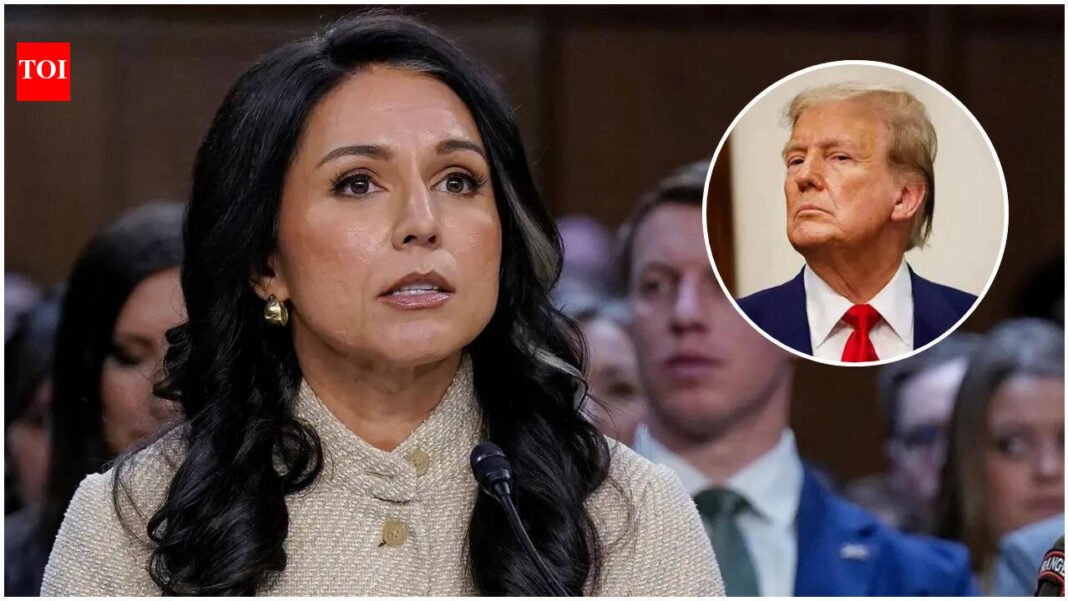

US intelligence chief says Iran has not rebuilt nuclear program, undercutting Donald Trump’s case for war
U.S. intelligence agencies have concluded that Iran is not trying to rebuild its nuclear enrichment capabilities that were destroyed in U.S. and Israeli attacks last year, according to testimony to Congress on Wednesday, a finding that contradicts one of President Donald Trump’s core assertions about the current war.director of national intelligence tulsi Gabbard In testimony prepared for the Senate Intelligence Committee, it said Tehran made “no effort” to restore its enrichment capabilities after the United States launched Operation Midnight Hammer in June 2025.
Gabbard’s written testimony contradicts core Trump claims
“As a result of Operation Midnight Hammer, Iran’s nuclear enrichment program was destroyed,” Gabbard said in prepared remarks.“Since then, there have been no attempts to rebuild their enrichment capabilities,” she added, according to AFP.The assessment is significant because Trump has repeatedly argued that he ordered the latest joint U.S.-Israeli military operation against Iran on February 28 because Tehran posed an “imminent threat” and was just weeks away from acquiring a nuclear bomb.The U.N. nuclear watchdog and many independent observers do not support the idea that Iran is about to build a nuclear bomb. The report also stated that Iran had been negotiating with Trump’s envoy on a possible agreement in the days before the attack.
Gabbard avoids repeating assessment at public hearing
Although this finding was included in her written testimony, Gabbard did not repeat it in public remarks on camera.When a Democratic senator pressed her on the issue, Gabbard said she didn’t have enough time to read the full testimony during the hearing, but she did not dispute the written assessment.That has only heightened tensions surrounding her appearance, as Democrats try to determine whether the intelligence community actually supports the administration’s overt declaration of war.Gabbard has repeatedly dodged questions about what intelligence she provided to Trump, frustrating Democratic senators who have used the annual global threats hearing to examine the sources of the widening conflict in the Middle East.When asked by Senator Mark Warner if she had warned Trump that Iran could close the Strait of Hormuz if it was attacked, Gabbard declined to discuss internal recommendations.The Associated Press quoted her as saying: “I have not and will not disclose internal conversations. What I will say is that we in the intelligence community will continue to provide the president with all the best objective intelligence available to help him make decisions.”
Joe Kent’s resignation deepens scrutiny of White House Iran threat rhetoric
Joe Kent’s resignation has heightened questions about the government’s rationale for war. Kent resigned as director of the National Counterterrorism Center on Tuesday, saying he could not “in good conscience” support Iran’s ongoing war and believed Tehran “posed no imminent threat” to the United States. Trump responded angrily, saying Kent was “very weak on security” and “it’s a good thing he quits.” The president also emphasized the position that Iran is a grave danger, saying, “Iran is a threat — and every country realizes that,” adding that officials who don’t believe Iran poses a threat are not people we “want” in the government. The White House has since repeatedly rejected Kent’s claims, insisting Trump has “strong and compelling evidence” that Iran is preparing to strike first.
CIA chief calls Tehran talks bad faith
While Gabbard’s written testimony cast doubt on the notion that Iran is racing to rebuild its nuclear program, CIA Director John Ratcliffe took a tougher stance on Tehran’s intentions.Ratcliffe told senators that Iran was not serious about diplomacy with Washington before the war.“It was clear that Iran had no intention of taking action at the time of the conversation,” Ratcliffe said.Ratcliffe rejected the assessment of former National Counterterrorism Center director Joe Kent, who resigned this week, and said Iran did not pose an imminent threat.“The intelligence reflects the opposite,” Ratcliffe told lawmakers.
Democrats put pressure on justification for war
The hearings quickly became a major test of the administration’s case for war.Democratic Senator Michael Bennet accused Trump of abandoning his anti-interventionist message.“President Trump says we are not the world’s policeman. That’s what he does,” Bennet said.“Now he has turned us into the police, the jury, the judge, the executioner of the world,” he added.Democrats also sought to use the hearing to pressure officials about the broader consequences of a war, including the risk that Iran could attack Gulf states or disrupt the Strait of Hormuz, a key route for oil and gas shipments.The hearing comes amid broader government scrutiny of the conduct of the war, including reports of concern over the investigation into a U.S. missile attack that allegedly hit an Iranian elementary school and killed more than 165 people, which the White House said is under review.
Gabbard says Iran’s regime is weakened but still intact
Gabbard said despite the devastation caused by weeks of attacks, the Iranian state remains.She told senators that the U.S. intelligence community believes the regime is “intact but largely weakened by attacks on its leadership and military capabilities.”Her comments came despite calling the cumulative impact of the movement serious. The war included the killing of Iran’s longtime supreme leader Ayatollah Ali Khamenei.Gabbard warned that if the current regime survives, it may try to restore its military strength over time.“If a hostile regime survives, it may seek to begin a years-long effort to rebuild its military, missile and drone forces,” she said.
Wider global threats: Russia, Ukraine and China
Gabbard used the hearing to lay out the broader threat landscape for the intelligence community beyond Iran.She said Russia still had the upper hand in the four-year-old war in Ukraine.“U.S. intelligence agencies assess that Russia maintains the upper hand in its war against Ukraine,” Gabbard said.She added that while U.S.-led peace talks between Moscow and Kiev continue, Russia will likely continue to fight a slow war until a deal is reached.Gabbard also warned of the danger of an “escalation spiral” in Ukraine or elsewhere that could lead to the use of nuclear weapons.Regarding China, she said Beijing is rapidly modernizing its military and has a long-term goal of seizing Taiwan, but the intelligence community believes China is still willing to create conditions for eventual “peaceful reunification” without war.