


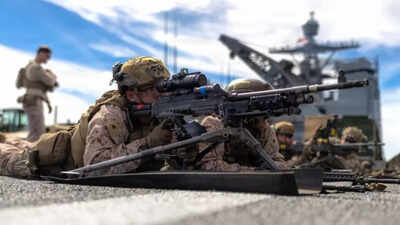
The United States is significantly expanding its military footprint in the region middle EastThousands of Marines and a powerful amphibious assault ship have been dispatched to the region as tensions with Iran rise. The deployment comes amid a rapidly escalating conflict between the United States, Israel and Iran that has triggered missile strikes, drone strikes and instability across the Gulf.According to reports, the Pentagon has ordered the amphibious assault ship USS Tripoli (LHA-7) and its Marine Expeditionary Unit to deploy to the region to transport thousands of combat-ready troops and advanced military equipment closer to the conflict zone. The move signals that Washington is preparing for a broader confrontation while also trying to protect U.S. strategic waterways and assets in the Middle East.
U.S. quickly builds military power in Iran-Israel war
The deployment reportedly includes approximately 2,000 to 2,500 Marines, as well as additional sailors and naval assets that will operate from the aircraft carrier USS Tripoli and its accompanying ships. The Marine Expeditionary Force is designed to be a highly agile force capable of performing a wide range of missions, including:
- amphibious assault
- evacuate civilians
- Attack enemy targets
- humanitarian action
- Securing strategic infrastructure.
Because these forces operate from amphibious ships rather than land bases, the U.S. military is able to respond quickly to crises without relying on host nation permission. Officials said the deployment was at the request of U.S. Central Command, which oversees U.S. military operations in the Middle East. The goal is to provide commanders with more options as tensions with Iran continue to escalate.
Why the U.S. is now sending Marines to Iran’s war with Israel
This decision was made against the backdrop of the rapid expansion of regional conflicts triggered by the US-Israeli attacks on Iranian military and nuclear targets in late February 2026. The attacks reportedly killed several senior Iranian leaders and damaged key military installations, prompting Tehran to launch retaliatory missile and drone strikes against Israeli and U.S. positions in the Gulf. Since then, the conflict has spread on multiple fronts:
- Iranian missiles, drones target Israel, Gulf states
- Shipping routes near the Strait of Hormuz were attacked
- Drones, militias attack US bases in Iraq, Syria
- Iran-backed groups launch rocket attacks in Lebanon.
The deployment of the Marines is widely seen as a precautionary measure aimed at deterring further Iranian escalation while ensuring the United States can respond quickly if the conflict expands.
The strategic importance of the Strait of Hormuz in the war between Iran and the United States and Israel
One of the main concerns driving the deployment is security in the Strait of Hormuz, one of the world’s most critical energy chokepoints. About a fifth of the world’s oil shipments pass through the narrow waterway, making it a vital artery for the global economy.Iran’s recent actions in the region, including threats to shipping and increased naval activity, have raised concerns that the strait may be disrupted or temporarily closed. This move will have an impact on global energy markets and may trigger a major international military response.Therefore, the arrival of amphibious ships and marines serves two purposes:
- Protect commercial routes
- Prepare for possible military escalation
What the USS Tripoli brought to the battlefield in the war between Iran and the United States and Israel
The Tripoli is an America-class amphibious assault ship that functions almost like a small aircraft carrier.It can host:
- More than 1,600 Marines
- Helicopters and tilt-rotor aircraft
- Advanced fighter jets such as F-35B
- Landing craft and armored vehicles.
This combination enables the ship to launch air strikes, amphibious landings and rapid reaction missions from the sea. By not requiring a nearby air base, the ship provides U.S. forces with the flexibility to operate in the Persian Gulf, Arabian Sea and surrounding areas. The Marine deployment is part of a broader U.S. military buildup in the Middle East that has been expanding since early 2026. These gatherings include:
- aircraft carrier strike group
- Fighters such as the F-35 and F-22
- missile defense system
- Additional naval battleships.
Analysts say the deployment is the largest in the region since the Iraq War. The build-up reflects growing concern in Washington that the conflict with Iran could escalate into a regional war involving multiple countries and armed groups.
Regional conflict between Iran and US-Israel war has expanded
The war between Iran and the US-Israeli alliance has had ripple effects across the Middle East. According to reports:
- Iran retaliatory attacks target U.S. bases, regional allies
- Hezbollah rocket launched from Lebanon
- The shipping disruptions have raised concerns about the impact on the global economy.
Civilian casualties are also rising in many countries, and governments in the region are bracing for further escalation. Meanwhile, international leaders, including European and Middle Eastern governments, have called for de-escalation and diplomatic negotiations.
What happens next in the Iran-U.S.-Israel war?
Military analysts say the deployment of Marines does not necessarily mean a ground invasion of Iran is imminent. Instead, the move provides the United States with several strategic options:
- Evacuate civilians from conflict areas
- Protect critical infrastructure and routes
- launch a limited attack or operation
- Prevent Iranian attacks on U.S. forces.
However, the presence of thousands of additional U.S. troops also significantly increases the risks. If Iran directly targets U.S. forces or allies, the conflict could quickly expand into a broader regional war.The deployment now underscores the level of turmoil in the Middle East in recent weeks. The arrival of the USS Tripoli and its marines shows that Washington is bracing for the possibility of further escalation as missile exchanges, drone strikes and maritime confrontations increase in the region.It remains to be seen whether the move serves as a deterrent or is a prelude to a wider war. The clear message, however, is that the Middle East is once again at the center of a geopolitical crisis that could reshape global security and energy markets for years to come.


