
In his 1931 book The Epic of America, James Truslow Adams coined a term that would come to define the classic life America promised to the rest of the world. As Adams described it, the “American Dream” is a social vision in which everyone’s life should be better, richer, and more fulfilling, providing opportunities based on ability and achievement rather than social class or origin.Inspired by this promise, Indians began to immigrate to the Americas in the 19th century, and their numbers increased significantly in the 20th century. America ticks all the boxes for them: city life, better incomes, better opportunities, and a slightly improved social status back home where they might otherwise spend their lives working but still end up being a family man instead of a billionaire.Parsi businessman Bhicaji Balsara became the first Indian to obtain U.S. citizenship through naturalization in 1910. But the peak of proud Indian-American symbolism came much later, with Satya Nadella becoming Microsoft CEO in 2014 and Sundar Pichai becoming Google CEO in 2015. What started as Punjabi farmers migrating to the U.S. West Coast eventually evolved into families taking loans worth hundreds of thousands of dollars to send their children to the U.S. so they could chase the American dream, not the cost.
The dark ages of indian americans
Fast forward to barack obamaDuring his term as president from 2009 to 2017. The number of Indian Americans appointed to senior government positions was at its highest during those years, when the community’s population was about 3 million, leading some to jokingly call Obama the first “Indian American president.”followed by Donald TrumpTrump was in power from 2017 to 2021. Despite Trump’s efforts to court Indian-American voters, he only received about 16% of the Indian-American vote in 2016. The 2020 Asian American Voter Survey later found that about 28% of Indian Americans supported him.Joe Biden’s election as president further strengthens Indian-American representation Kamala Harris as his 2020 running mate. Harris then served as vice president from 2021 to 2025, becoming the first person of Indian descent to hold the position.Trump’s re-election in 2025 marks the beginning of what he calls America’s “golden age.” For many Indian Americans, however, the political and cultural climate since then has been far less rosy.
Indian Americans are exhausted
Anti-Hindu amplification
Tracking Hinduphobia Online
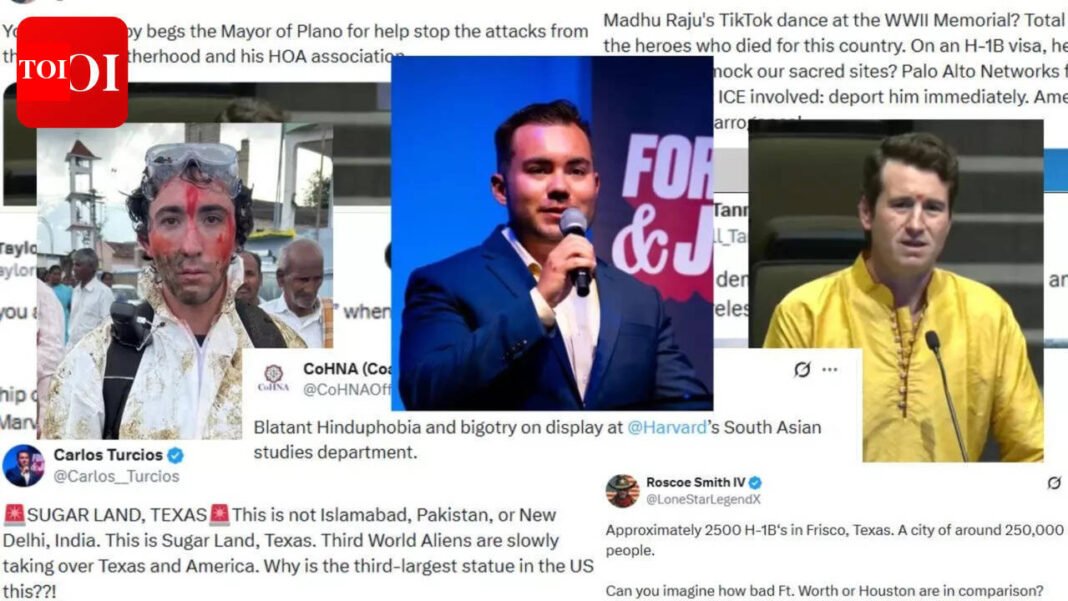
In October 2025, anti-H1B hatred erupted online with slurs targeting only Hindu gods, traditions, and names. Carlos Turcios, a Republican activist in the Dallas-Fort Worth area, ranted against Texas’ 90-foot-tall “Confederate statue” of Lord Hanuman in a February X post that went viral, claiming that “Third World aliens” were slowly taking over Texas and the United States. Many other posts ranted about “demon gods” and “monkey gods,” and a best-selling author spoke out against immigrants entering the temple. Around the same time, American YouTuber Tyler Oliveira’s A video mocking the festival of Gorehaba, a village in Karnataka, has received 5 million views on X. Instead of making an effort to understand the significance of the festival or talking to locals, he criticized it with the title “Inside India’s Poop Throwing Festival,” seducing Americans into waiting for a spoof of the country and its culture. Critics argued that the video failed to explain the cultural or ritual context of the festival and instead encouraged mockery of Indian traditions.In another video that went viral on The conservative media personality satirically mocked the culture’s cow worship and use of cow dung and urine, causing many Indian Americans to quit.Whether because of the incident or broader cultural tensions, almost a fifth of respondents shy away from wearing bindis and tilaks, and 23% of Indian Americans believe Hindus face severe personal discrimination, the Carnegie survey noted. Furthermore, by 2022, Internet Infection Research Institute Rutgers University researchers have documented a pattern in which social media is systematically weaponized, often by bots and geopolitical actors, to target Hindu communities. It also warned the Hindu community to be cautious as hate online often creeps into the real world.
Attacks beyond social media
Expressions of Hinduism, including temples and idols, have also been targeted. In 2025, a shooting occurred at an ISKCON temple in Utah while worshipers were inside. Several Hindu temples were vandalized in Indiana and Southern California, and a temple statue was attacked in North Carolina. California has also recorded an increase in hate crimes involving Hindus, although anti-Semitism remains the most reported category of religious hate crimes in the state.Agencies also face accusations of insensitivity. In February 2026, Harvard was accused of “blatant Hinduphobia” by the Hindu Alliance of North America, which accused Harvard of displaying artwork for a Sanskrit course on its South Asian Studies department website. The coalition accused the university of bigotry on “X,” adding an image “straight out of a horror movie” featuring a dark Hindu figure wearing a tilak “holding some kind of ghostly statue in his hand.” While the university issued an apology on its website on behalf of the department, saying it “deeply regrets” sharing the “insensitive” image, it echoed the ignorance of the deep-seated issues of Hinduism even among America’s prestigious academic institutions.
Madhu Raja Controversy
The latest example of anti-Hindu hatred is a video of Indian-origin techie Madhu Raja filming the “Don’t Rush Challenge” with a woman in front of a monument on the National Mall honoring Americans who served in the armed forces during World War II and those who lost their lives in the war. After the video circulated online, Raja was reportedly doxxed and forced to delete his social media accounts. He is believed to be employed by Palo Alto Networks, and calls for his firing have gone viral.Some posts also called for Raja’s deportation, claiming he was in the country on a non-immigrant H-1B visa.Before then, videos of American cheerleaders doing somersaults at the Lincoln Memorial, white brides dancing in the reflecting pool, men in Spider-Man costumes tumbling around World War II fountains, and many other similar videos that “disrespected” American history flooded the Internet every day.
What is the future for Indian Americans?
A study by Internet Infection Research Institute (NCRI) claims that by 2025, 24,000 posts on X will have more than 300 million views. Anti-India content on the platform has tripled in just one year. anti indian hatred Hinduphobia has orphaned Indians, and the second biggest thing that makes them stand out in a world dominated by capitalism and influenced by evangelicalism is their religion, the first being, of course, their bold audacity of talent. For many observers, the trend raises difficult questions about assimilation and identity.Take Indian-American golfer Akshay Bhatia, for example, who had a dramatic playoff victory at the Arnold Palmer Invitational in March 2026. Some online commentators noted that he seemed to have fully assimilated into American culture, arguing that there were few overt markers of Indian identity beyond his name.“Another thing you missed about Akshay Bhatia is – assimilation,” said one post on X, like many others. In the Carnegie survey, although Indian Americans are ready to assimilate into their own culture and give up tilaks, bindis, etc., they still do not intend to leave the country, and most suggest going to the United States for employment. As civilians of the country, Indians have had to barter to survive since ancient times. Under the rule of the British colonials, they became sepoys and babus, while the Mughals, Subedars and Mansabdars became sepoys and babus, all of whom were able to live on their own land, in their own society and culture, while practicing their own religion. For generations, immigrant communities in the United States have maintained a delicate balance between assimilation and cultural preservation. Indian Americans today face a similar dilemma: how to maintain a distinct cultural identity in a political environment increasingly shaped by debates about immigration, nationalism, and global competition.The American Dream promises opportunities that cannot be erased. For many Indian Americans, the coming years may determine whether that promise remains valid.