


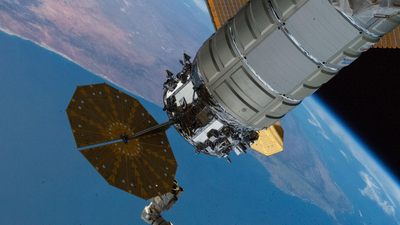
Expedition 74 astronauts aboard the International Space Station (ISS) are preparing for a critical spacewalk while advancing microgravity research. NASA Flight engineers Jessica Meir and Chris Williams prepare spacesuits, clean cooling circuits and review procedures for a March 18 extravehicular activity (EVA) in the Quest airlock. They will modify and wire the seventh launch solar array mounting kit to enhance the International Space Station’s power capacity. Meanwhile, Jack Hathaway and ESA’s Sophie Adenot tested EchoFinder-2, an AI-powered augmented reality ultrasound device in the Columbus module that automatically scans organs to reduce the remote mission’s reliance on Earth. NASA further reported that Roscosmos cosmonauts Sergey Kud-Sverchikov and Sergey Mikayev used sensors to monitor blood vessel health, while Andrei Fedyaev maintained the oxygen generator and water systems. Northrop Grumman’s Cygnus XL, which has transported 11,000 pounds of cargo since September 2025, undocking via Canadaarm2 on March 12 and returned to the Pacific Ocean. These efforts blend maintenance and science, fueling deep space ambitions driven by President Artemis. Live broadcast begins at 6:45 a.m. ET on all NASA platforms.
Preparing for a spacewalk on the International Space Station
NASA flight engineers Jessica Meir and Chris Williams are leading the spacewalk scheduled for March 18. Inside the Quest airlock, the duo carefully cleaned the suit’s cooling circuits, replenished water components and inspected the helmet to ensure everything was functioning perfectly during the six-and-a-half-hour extravehicular activity (EVA). Their mission? Installing retrofit kits and routing cables on the International Space Station’s port side for future solar arrays, the seventh such array used to increase the station’s power generation. As they posted on the The spacewalk highlighted continued upgrades to the International Space Station to keep it powered despite aging infrastructure.Veteran astronaut Jessica Meir, with her previous EVA experience, worked seamlessly with Chris Williams, who has been adjusting to life on the space station since November. Their teamwork in the Quest airlock not only prepares the hardware but also reviews emergency procedures, which are critical in the harsh vacuum of space. Augmented reality and artificial intelligence in space health checksInnovation thrives not just outside the station, but inside it as well. NASA flight engineer Jack Hathaway and European Space Agency (ESA) Sophie Adenot conduct an augmented reality-guided ultrasound scan using the EchoFinder-2 device in the Columbus laboratory module. They imaged each other’s abdomens and vascular systems, and artificial intelligence analyzed the data to automatically identify organs. “EchoFinder-2 opens the door to autonomous ultrasound for space missions using minimal training and low-tech hardware,” explains ESA’s report on the technology, which reduces reliance on Earth-based experts, which is critical for future journeys to Mars where signal delays will be as long as 20 minutes. Adenot, on her first mission since February 2026, swapped roles with U.S. Navy Captain Hathaway, who has more than 2,500 flight hours, to test the system’s reliability in weightless conditions. Meanwhile, a NASA blog further asked Roscosmos astronauts Sergey Kud-Sverchkov and Sergey Mikayev to monitor circulatory health through blood pressure cuffs and sensors on their foreheads, fingers and toes. The data transferred to the laptop could help doctors track the effects of microgravity on the vascular system, from fluid shifts to potential blood clots. Flight Engineer Andrey Fedyaev keeps life support systems running, maintains the Elektron oxygen generator in Zvezda’s cabin, and purifies water tanks to ensure supplies for the crew.
Cygnus cargo spacecraft leaves International Space Station
Northrop Grumman’s Cygnus XL cargo spacecraft has concluded a six-month stay that began on September 18, 2025, and is expected to undocking on March 12. Filled with junk and experiments, it will be grabbed by the Canadaarm2 robotic arm in the Unity module, then released before re-entering over the South Pacific. The mission delivered more than 11,000 pounds of supplies, hardware and science payload under NASA’s Commercial Supply Services program. Space Coast Daily confirmed that “Cygnus XL, operated by Northrop Grumman, is scheduled to depart the International Space Station on Thursday, March 12,” noting that NASA+ began live streaming at 6:45 a.m. ET.Sophie Adenot will oversee Cygnus’ systems post-launch to ensure a smooth exit. The departure clears docking ports for future missions and maintains the International Space Station’s role as a springboard for deep space ambitions.
Expedition 74 astronauts: groundbreaking spacewalk
Expedition 74 will be implemented from December 2025 and combines the expertise of NASA, ESA and Roscosmos in biology, physics and human physiology research. From solar panel upgrades to power outposts of the future to artificial intelligence diagnostics paving the way for autonomous medicine, these events attract a global audience.As President Trump’s administration looks to Artemis and beyond, the International Space Station remains Earth’s orbiting laboratory, with today’s tweaks like the rollout of solar arrays to provide sustainable power for expanding humanity’s presence in space. Watch the live broadcast and witness history unfold 400 kilometers above us.


, are gearing up for a pivotal spacewalk while advancing microgravity research.)