

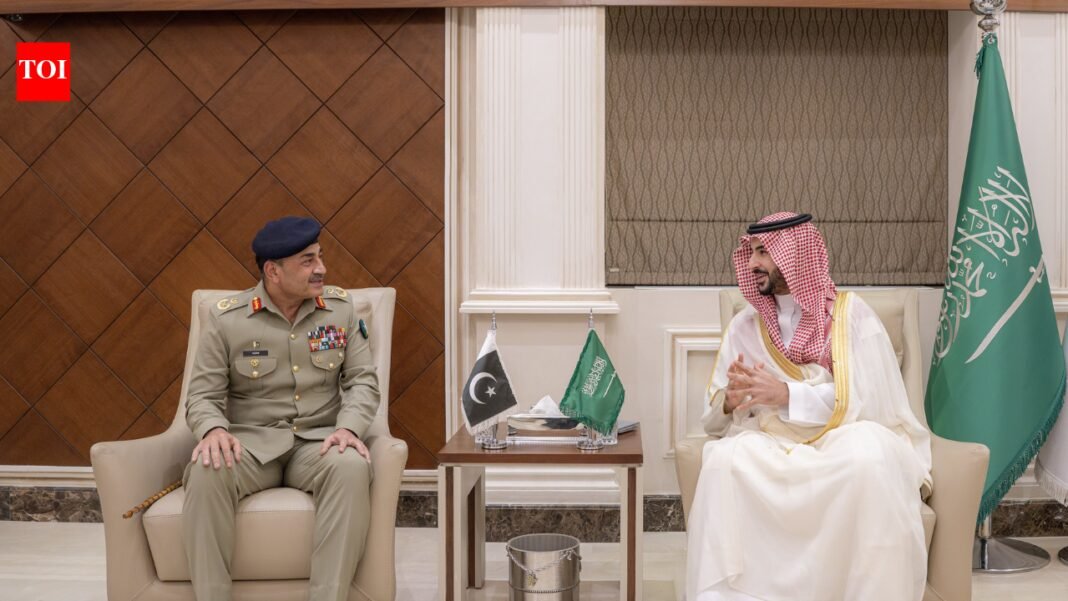
Pakistan chief of army staff and de facto leader of the country Asim Munir As the situation in the Middle East continues to change, I met with Saudi Arabia’s Defense Minister Khalid bin Salman. The meeting came just days after an attack on Saudi Arabia’s Aramco oil refinery, a joint U.S.-Israeli strike that killed Iran’s Ali Khamenei, triggering Tehran to launch a powerful retaliatory military campaign across the Middle East and raising fears of a wider regional conflict.The Saudi defense minister shared details of the meeting on X while highlighting Iran’s attacks on the kingdom. He shared a photo with Munir and wrote: “Meeted with the Chief of Army Staff and Commander-in-Chief of the Defense Forces, Field Marshal Asim Munir. We discussed Iranian attacks on Pakistan and the measures required to stop them within the framework of our Joint Strategic Defense Agreement. We emphasized that such actions undermine regional security and stability and expressed hope that Iran will use its wisdom to avoid miscalculation.”This meeting can be considered of strategic importance. According to Bloomberg, a few months ago, Turkey sought to establish a triangular defense alliance in the form of an “Islamic NATO” with nuclear-armed Pakistan and Saudi Arabia, aiming to reshape security alliances in the currently turbulent Middle East and other regions.When Saudi Aramco refineries were attacked by Iran a few days ago, Pakistan reacted strongly, expressing solidarity with Riyadh and other Gulf states.As tensions continue to escalate and Iran maintains missile and drone attacks, there are questions over whether Islamabad’s response will go beyond verbal condemnation given its 2025 strategic mutual defense agreement with Riyadh.The deal, initially signed by Pakistan and Saudi Arabia in September, reportedly states that “any aggression” against one member state will be considered an attack against all member states, a provision similar to NATO’s Article 5 under which member states commit to collective defence.Negotiations over Türkiye’s possible entry into the arrangement are said to be at an advanced stage and a deal seems likely, people familiar with the matter told Bloomberg on condition of anonymity. The proposed expansion reflects the growing overlapping strategic interests of Türkiye, Saudi Arabia and Pakistan in parts of South Asia, the Middle East and Africa, the report said.