

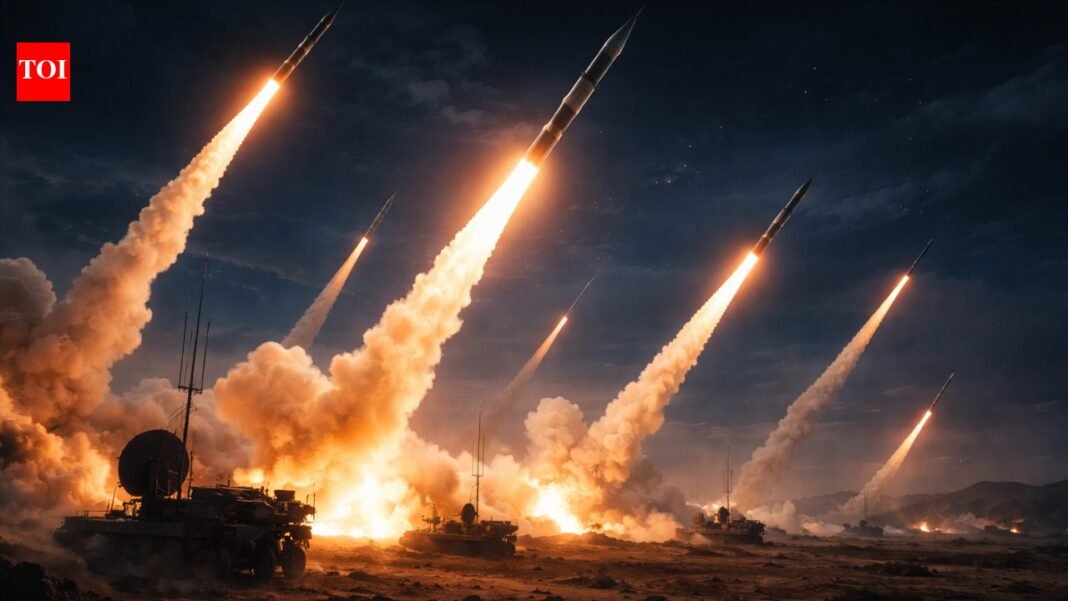
Is Iran about to run out of ballistic missile arsenal?The Middle East remains on edge after U.S. President Donald Trump’s epic Wrath campaign and Israel’s Operation Roaring Lion targeted Iran’s leadership and military infrastructure, killing Iran’s longtime leader Ayatollah Ali Khamenei and triggering a wave of retaliation from Tehran across the region.Since then, Iran has launched missile and drone attacks on U.S. military bases, Israel and multiple Gulf countries. But a new report suggests Tehran’s most powerful weapon, its ballistic missile force, may already be under severe strain.A report from the Jewish Institute for National Security Studies in America (JINSA), an American think tank, said that attacks by the United States and Israel have significantly weakened Iran’s ability to launch missiles in the current war.
Missile attacks drop sharply
JINSA said the number of Iranian ballistic missile launches has dropped by about 90% since the beginning of the conflict. Attacks against Israel alone have decreased by approximately 88%.The report also noted that Iran fired more missiles on the first day of Israel’s early Operation Lion last year than in the first five days of the current war combined.The think tank said the U.S.’s Operation Epic Fury and Israel’s Operation Roaring Lion had reduced Iran’s daily missile launches to a rate nearly three times faster than during the conflict in 2025.
The transmitter becomes the weak link
A major reason for the decline was the destruction of missile launchers. JINSA estimates that approximately 75% of Iran’s launch capabilities were destroyed within a short period of time.Launchers have become a major bottleneck in Iran’s missile operations. Whenever Iran launches a missile, U.S. and Israeli forces have another opportunity to locate and destroy the remaining launch systems.As a result, Iran has shifted from large-scale missile attacks to smaller, less frequent attacks.
Inventories under pressure
Iran entered the war with a large stockpile of missiles – about 2,000 medium-range ballistic missiles capable of reaching Israel, and 6,000 to 8,000 short-range missiles designed to strike regional targets.However, ongoing attacks have destroyed many of the missiles and disrupted the logistics needed to transport them from storage locations to launch sites.The loss of medium-range missiles is particularly damaging because these systems were specifically designed to target Israel and cannot be easily replaced by short-range weapons.JINSA said that at the current rate of losses, Iran could lose most of its ability to launch these missiles at Israel within a few days to a week.
Strategy shifts to Gulf targets
The report also noted that Iran has expanded the scope of its attacks to the entire region, not just targeting Israel. By targeting Gulf states, Tehran may seek to increase pressure on U.S. allies and expand the political impact of the conflict.This approach would also require different missiles – long-range systems for Israel and short-range missiles for the Gulf states.
Drones and agents may be next
As its missile-launching capabilities shrink, Iran is expected to increasingly rely on drones and allied proxy groups.Lebanese Hezbollah, Iran-backed Iraqi militias and Yemen’s Houthi rebels could play a larger role in attacks against Israel, U.S. forces and Gulf states.Kinsa said Iran may still try to carry out occasional missile strikes or even a one-off large-scale attack. But such an attack would quickly deplete its remaining transmitters.Overall, the report concluded that Iran’s missile activity is likely to continue to shrink as U.S. and Israeli strikes destroy launchers and disrupt supply lines, forcing Tehran to rely more on drones and proxy warfare to pressure its adversaries.